
Nano ceramic coating protects your car from UV rays and prevents fading by forming a chemically bonded, silicon-dioxide (SiO₂) layer over the clear coat that reflects ultraviolet radiation, slows heat transfer, blocks oxidation, and seals microscopic paint pores. This barrier reduces sun damage, color fading, and surface breakdown while preserving gloss and paint integrity for years, especially in high-UV climates like Dubai.
1. Why UV Damage Is a Real Problem for Car Paint
Ultraviolet radiation is one of the main reasons car paint loses color over time. In regions with strong sunlight, UV exposure breaks down paint pigments and clear coat resins. This process leads to oxidation, fading, dullness, and surface weakening.
In desert and coastal environments, UV damage increases because:
- Sun exposure is more intense and frequent
- Heat accelerates chemical reactions
- Dust and sand create surface abrasion
- Humidity and salt can increase chemical etching
Once oxidation begins, paint becomes porous. That allows more UV rays and contaminants to penetrate deeper into the surface.
2. What Is Nano Ceramic Coating?
Nano ceramic coating is a liquid polymer coating made primarily from silicon dioxide (SiO₂). When applied to a car’s exterior, it chemically bonds with the factory clear coat, forming a hardened, transparent, glass-like layer.
Unlike wax or sealants:
- It does not sit loosely on the surface
- It does not melt under heat
- It does not wash away easily
The coating fills microscopic paint pores, creating a dense surface with low surface energy. This is what gives it hydrophobic, UV-resistant, and oxidation-blocking properties.
3. How UV Rays Cause Paint Fading and Oxidation
Car paint is made of pigments protected by a clear coat. UV radiation affects both layers.
UV damage happens in stages:
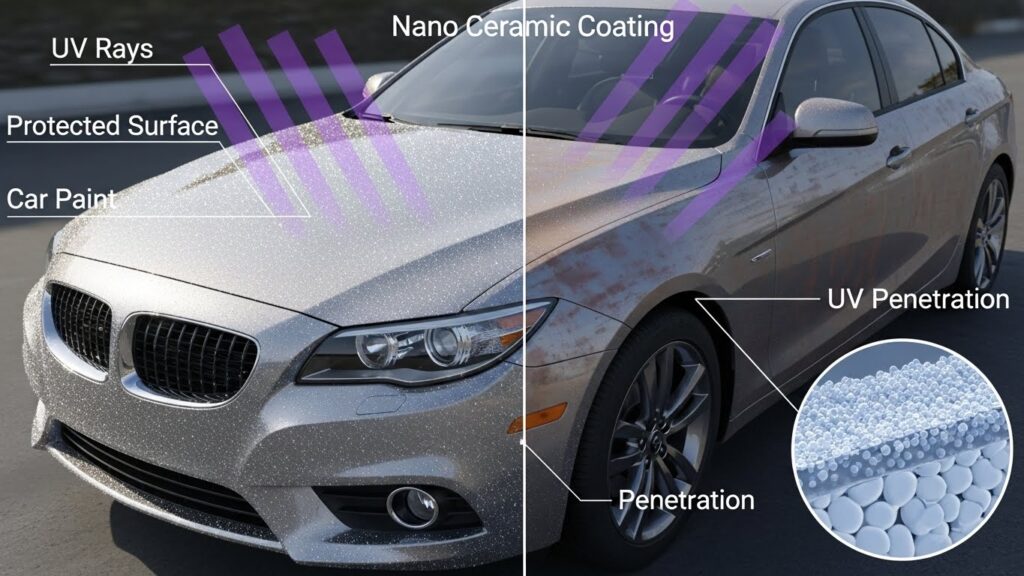
- UV rays penetrate the clear coat
- Heat and radiation break molecular bonds
- Paint pigments lose stability
- Oxidation forms on the surface
- Color fades and gloss reduces
Dark colors absorb more heat, which speeds up fading. Without protection, paint degradation becomes visible within a few years.
4. The Science Behind Nano Ceramic Coating and UV Protection
Nano ceramic coatings work because of surface chemistry and nanotechnology.
Key scientific mechanisms:
- SiO₂ particles form a dense crystalline network
- The coating reflects and scatters UV radiation
- Infrared heat transfer is reduced
- Oxygen interaction with paint is slowed
- Chemical reactions causing oxidation are delayed
This creates a UV-resistant barrier that protects the clear coat before damage begins.
Because the coating is chemically bonded, it stays stable under high temperatures and does not degrade like organic waxes.
5. How Nano Ceramic Coating Prevents Paint Fading
Paint fading happens when UV exposure breaks down pigment molecules. Nano ceramic coating helps by:
- Blocking direct UV penetration
- Reducing heat buildup on the surface
- Preventing oxidation reactions
- Maintaining pigment stability
- Preserving paint clarity and color depth
The result is long-term color retention, even under continuous sun exposure.
This is especially important for vehicles parked outdoors or driven daily in sunny environments.
6. How Heat and Infrared Radiation Affect Car Paint
UV rays are not the only issue. Infrared radiation raises surface temperatures, which speeds up paint aging.
High temperatures:
- Soften clear coat resins
- Increase oxidation speed
- Cause micro-cracking over time
Nano ceramic coatings help by:
- Reflecting part of the heat load
- Creating a thermal buffer
- Stabilizing the surface structure
This reduces heat-induced paint stress, especially on darker vehicles.
7. Hydrophobic Properties and Surface Protection
Nano ceramic coating creates a hydrophobic surface, often described as the lotus effect.
What this does:
- Water beads up and rolls off
- Dust and grime lift away easily
- Mineral deposits are reduced
- Contaminants cannot bond strongly
By keeping the surface cleaner, the coating indirectly:
- Reduces chemical staining
- Minimizes UV-accelerated residue damage
- Protects against water spots
A cleaner surface reflects light better and stays cooler.
8. Nano Ceramic Coating vs Traditional Wax
Many people ask whether wax is enough for UV protection.
Key differences:
| Feature | Traditional Wax | Nano Ceramic Coating |
|---|---|---|
| UV resistance | Limited | High |
| Heat stability | Low | Very high |
| Durability | 1–3 months | 2–5+ years |
| Chemical bonding | No | Yes |
| Oxidation resistance | Minimal | Strong |
| Maintenance | Frequent | Low |
Wax offers short-term shine. Ceramic coating offers long-term paint protection.
9. Nano Ceramic Coating vs Paint Protection Film (PPF)
These two solutions protect paint in different ways.
Nano ceramic coating:
- Protects from UV, oxidation, chemicals
- Enhances gloss and clarity
- Makes cleaning easier
Paint protection film:
- Absorbs physical impacts
- Prevents rock chips and scratches
Many vehicle owners combine both:
- PPF on high-impact areas
- Ceramic coating over the entire surface
This approach covers both chemical and physical threats.
10. How Long Does Nano Ceramic Coating Last?
Durability depends on:
- Coating quality
- Application process
- Maintenance routine
- Environmental exposure
Typical lifespan:
- Entry-level coatings: 1–2 years
- Professional coatings: 3–5+ years
- Multi-layer systems: longer with care
The UV-blocking properties remain effective as long as the coating structure stays intact.
11. Maintenance Tips to Keep UV Protection Effective
To maintain UV resistance:
- Use pH-neutral shampoos
- Avoid automatic brush washes
- Wash in shade
- Dry with microfiber towels
- Remove contaminants quickly
Occasional ceramic booster sprays can help maintain hydrophobic performance.
Common Questions People Ask About Nano Ceramic Coating
Does ceramic coating block UV rays?
Yes. It reflects and filters UV radiation before it reaches the paint.
Will ceramic coating stop fading completely?
It significantly slows fading but does not make paint immune to time.
Does ceramic coating protect clear coat?
Yes. It strengthens and seals the clear coat surface.
Is ceramic coating better than waxing for sun protection?
Yes. It offers longer-lasting and stronger UV resistance.
Final Thoughts: Is Nano Ceramic Coating Right for You?
If your car faces regular sun exposure, heat, and environmental stress, nano ceramic coating provides reliable UV protection and fading prevention. It works by combining surface chemistry, thermal resistance, and oxidation control into one durable layer.
From my experience, vehicles with ceramic coating maintain color clarity and surface stability far longer than unprotected paint. With proper application and care, it becomes a long-term solution rather than a temporary fix.