

Residential blackout window film is for rooms where the household needs much stronger visual separation and lower transmitted light than ordinary privacy tint or frosted film can provide. It belongs under Car Cool’s Home Window Tinting range, but its macro context is deliberately narrow: how opaque film changes privacy and light inside a home.
Bedrooms, nurseries, media rooms, internal glass partitions and exposed utility areas can benefit when a clear view through the glass is no longer required. The trade-off is daylight. Because blackout film uses very low visible-light transmission or opaque construction, it can make a room significantly darker than frosted film or residential privacy film.
For the general product concept, finish options and non-residential applications, see the parent Blackout Window Film page.
Where Residential Blackout Film Makes Sense
Bedrooms: useful where outside views are not needed and the priority is a darker, more private sleeping environment. Nurseries: consider blackout film when daytime naps require strong light reduction, while still ensuring safe ventilation and normal room lighting when needed. Media rooms: low transmitted light can help control screen reflections and visual distractions. Internal glass: opaque film can convert a transparent partition or door into a visually private surface without replacing the glass.
Blackout film is not automatically the best choice for every home window. Living rooms and spaces that depend on daylight may be better served by solar-control, reflective privacy or frosted film. Choose according to room function, orientation, view requirements and glass type.
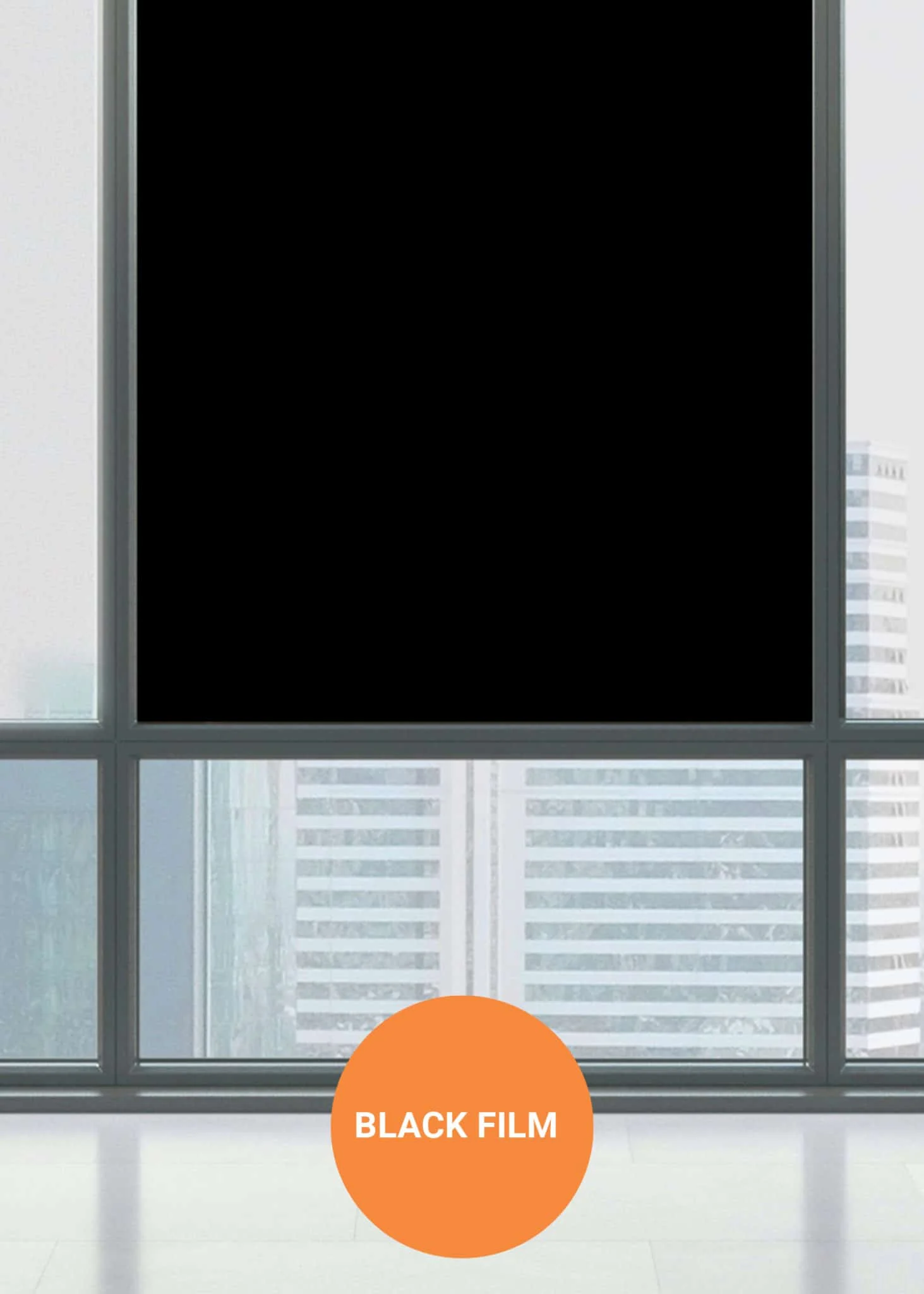
What to Check Before Installing Blackout Film at Home
Glass type: identify whether the pane is tempered, laminated, single glazed or insulated before selecting film. Daylight loss: understand that an opaque finish can materially darken the room. Exterior appearance: check how the selected colour will look from outside, especially on facade-facing windows. Coverage: decide whether the full pane or only a privacy zone needs blackout treatment. Edges and seals: installation should avoid damaging gaskets, frames and adjacent finishes.
If the requirement is privacy without losing most daylight, use frosted film. If the requirement is daytime privacy while preserving a clearer view, use residential privacy film.
Blackout Film vs Curtains, Frosted Film and Privacy Tint
Blackout film is fixed to the glass and provides strong obscuration without a fabric covering. Blackout curtains can be opened whenever daylight and a full view are wanted, so they may be more flexible for living spaces. Frosted film preserves diffused daylight but does not provide a clear view. Reflective privacy tint can preserve more of the outside view during the day, but privacy changes with lighting conditions.
The best option depends on whether your priority is darkness, permanent visual privacy, daylight, view preservation or flexible control. Car Cool can assess those requirements as part of the wider Residential Window Tinting service.
Frequently Asked Questions About Residential Blackout Film
Is blackout film good for bedroom windows?
It can be a good choice when you want strong visual privacy and a much darker room, but it removes more daylight than frosted or privacy film. Consider how often you want a clear view before choosing permanent opaque coverage.
Can blackout film help a nursery stay darker during the day?
Yes, a very low-VLT or opaque film can reduce daylight through the treated glass. Confirm the exact film’s light-transmission data and keep normal room lighting, ventilation and safety needs in mind.
Will residential blackout film provide privacy at night?
Opaque film does not rely on brighter outdoor lighting, so it can provide consistent visual obscuration after dark. The exact privacy level depends on the film’s opacity and coverage.
Can I use blackout film only on part of a window?
Yes. Partial-height or zone coverage can hide a specific sightline while leaving another part of the glass open, although the finished design should be planned carefully.
Is frosted film better for a bathroom?
Often yes when the goal is privacy plus daylight. Frosted film diffuses light, while blackout film is more appropriate when you also want to substantially darken the opening.
Should blackout film be professionally installed?
Professional installation is recommended for large panes, visible facade glass and multi-panel layouts. It helps with glass compatibility, accurate cutting, edge finish and consistent seams.